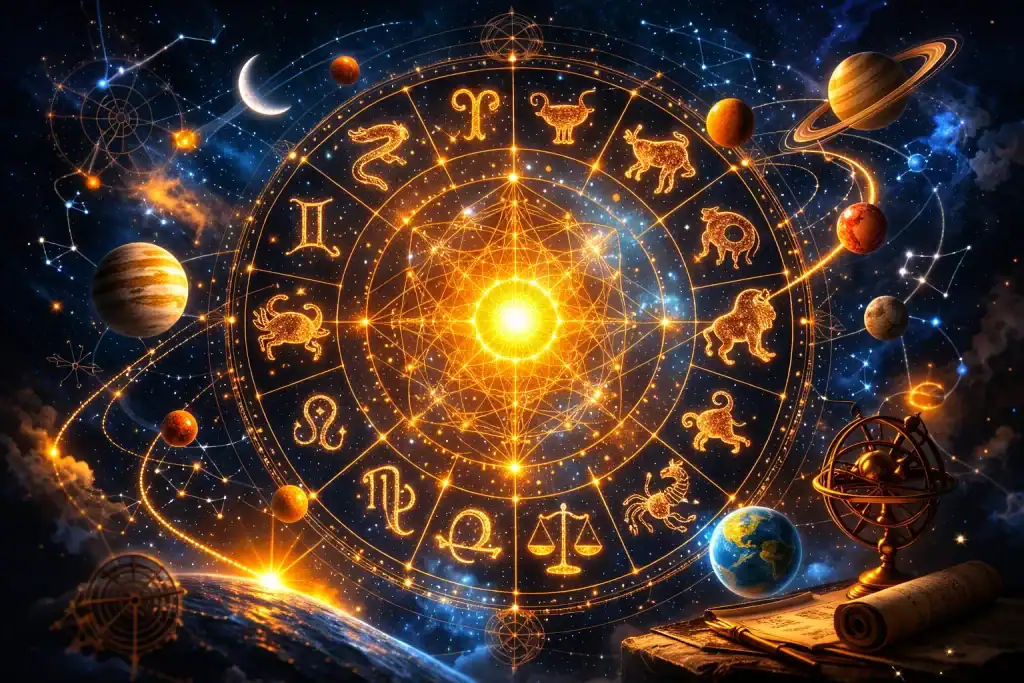
Many people know zodiac signs only through newspaper horoscopes or personality descriptions. But in Vedic astrology, zodiac signs (Rashis) are far more than symbolic labels. They form the basic coordinate system through which planets are measured, charts are constructed, and predictions are made.
A common question people ask is whether these signs are real astronomical structures or simply something imagined by ancient astrologers. To understand the role of zodiac signs in astrology, it is necessary to first understand what they actually represent.
Get Your Vedic Kundali Report Free (60+ pages with all yog & dosh)
What Exactly Are Zodiac Signs
Zodiac signs are twelve equal divisions of the celestial belt through which the Sun, Moon, and planets appear to move. This belt is known as the ecliptic.
Ancient astronomers observed that most planetary motion occurs within a narrow band of the sky surrounding this path. To track planetary movement accurately, this circular belt of 360 degrees was divided into twelve equal segments of 30 degrees each.
These twelve divisions became the zodiac signs.
Each sign was named after a nearby constellation traditionally visible in that region of the sky. In Vedic astrology these are known as the twelve Rashis:
- Mesha (Aries)
- Vrishabha (Taurus)
- Mithuna (Gemini)
- Karka (Cancer)
- Simha (Leo)
- Kanya (Virgo)
- Tula (Libra)
- Vrischika (Scorpio)
- Dhanu (Sagittarius)
- Makara (Capricorn)
- Kumbha (Aquarius)
- Meena (Pisces)
It is important to understand that the zodiac signs themselves are not the constellations. They are fixed mathematical segments of the sky used for measuring planetary positions.
Are Zodiac Signs Real or Just Imagined
This question often arises because zodiac signs cannot be physically seen like planets or stars.
Astronomically, the constellations along the ecliptic are not equal in size. Some cover very small regions of the sky while others span much larger areas. For accurate calculation, ancient astronomers standardized the system by creating twelve equal 30-degree divisions.
These divisions function as celestial coordinates, much like longitude and latitude on Earth.
While zodiac signs are not physical bodies, they represent specific zones of planetary movement along the ecliptic. Over centuries of observation, astrologers noticed that planets placed in certain zones repeatedly produced similar patterns in personality, behavior, and life events.
Because of these repeatable correlations, zodiac signs became an essential framework for understanding planetary influence.
In this sense, zodiac signs are mathematical reference zones with symbolic meaning, rather than imaginary constructs.
Zodiac Signs in Vedic Astrology
In Vedic astrology the zodiac follows the sidereal system, known as the Nirayana zodiac. This system measures planetary positions relative to fixed stars.
The twelve Rashis form the foundation of every birth chart. When a planet is said to be in a particular sign, it simply means that the planet occupies that specific 30-degree portion of the celestial circle.
Each Rashi has certain inherent qualities. These include its elemental nature (fire, earth, air, or water), its behavioral mode, and its ruling planet.
For example:
- Aries is ruled by Mars and expresses initiative and courage.
- Taurus is ruled by Venus and represents stability, comfort, and material security.
- Gemini is ruled by Mercury and relates to intellect and communication.
These qualities influence how planetary energy manifests when a planet occupies that sign in a horoscope.
Vedic vs Western Zodiac: The Key Difference
Both Vedic and Western astrology use the same twelve zodiac signs, but they calculate them differently.
Western astrology generally uses the tropical zodiac, which is tied to Earth’s seasonal cycle. In this system, the zodiac begins at the vernal equinox, the point where spring begins in the northern hemisphere.
Vedic astrology, on the other hand, uses the sidereal zodiac, which remains aligned with the background of fixed stars.
Because of a phenomenon known as precession of the equinoxes, the tropical zodiac slowly shifts relative to the stars by roughly one degree every seventy-two years. Over centuries this creates a noticeable difference between the two systems.
As a result, many people who identify with a particular Sun sign in Western astrology may find their Sun placed in a different sign in the Vedic system.
The two approaches are not necessarily contradictory. They simply use different astronomical reference points. Western astrology often emphasizes psychological interpretation, while Vedic astrology focuses more on karmic patterns and predictive techniques.
Importance of Zodiac Signs in Calculative Astrology (Ganit Jyotish)
In the mathematical branch of astrology, zodiac signs function as a precise measurement system.
Every planetary position is recorded by its degree within a zodiac sign. For example, a planet might be located at 12 degrees Taurus or 27 degrees Sagittarius.
These exact measurements allow astrologers to calculate:
- planetary positions in the birth chart
- aspects between planets
- exaltation and debilitation points
- divisional charts such as Navamsa or Dasamsa
- planetary strength and dignity
Ephemeris tables and modern astrology software rely entirely on this 360-degree zodiac framework. Without the twelve 30-degree signs, accurate planetary calculations would not be possible.
Importance of Zodiac Signs in Predictive Astrology (Phal Jyotish)
While the zodiac provides the coordinate system for calculation, it also plays a crucial role in interpretation.
In predictive astrology, zodiac signs describe the environment in which planetary energies operate.
For instance, a planet placed in a fire sign may act with initiative and dynamism, while the same planet in a water sign may express emotion and sensitivity. The sign modifies how the planet behaves and how its results manifest in life.
Zodiac signs are used in several key predictive techniques:
- analyzing planetary transits (gochar)
- interpreting dasha periods
- evaluating house rulership
- determining planetary dignity
- understanding personality traits and life tendencies
In combination with houses, planetary strength, and timing systems, zodiac signs help astrologers interpret themes related to career, relationships, health, finances, and personal growth.
The Role of Zodiac Signs in the Birth Chart
In Vedic astrology, the zodiac sign rising on the eastern horizon at the moment of birth becomes the Ascendant (Lagna). This sign determines the structure of the entire horoscope.
From the ascendant, the twelve houses are arranged and the placement of planets across signs and houses is analyzed.
The interaction between planet, sign, and house creates the framework from which astrologers derive predictions and life insights.
Without the zodiac signs, the entire structure of the birth chart would collapse.
Understanding the Deeper Meaning
Zodiac signs are neither random imagination nor rigid fate. They represent a structured way of mapping planetary movement and interpreting the patterns that arise from it.
For thousands of years, astrologers have observed how planets behave when positioned within different segments of the zodiac. These observations gradually developed into the interpretative system used in astrology today.
Understanding the role of zodiac signs helps reveal how astrology combines astronomical measurement with symbolic interpretation to study patterns in human life.
A simple Sun-sign description can never capture the full complexity of a birth chart. True astrological interpretation requires examining the entire planetary configuration within the zodiac.